Lightning Ridge is an opal mining town in northern New South Wales. It’s surrounded by flat, bare countryside and there are no high-rise buildings so the first warning that you’re approaching the community is a sign that says “Lightning Ridge - Population?”
It’s always been a favourite place for those who just want to disappear, for whatever reason, and there are many in the town living a marginal or non-existent life as far as the authorities are concerned. That’s why the post office receives mail for a couple of thousand more people than are actually registered to live there.
Talk to people in this small, hot, dusty, fly-plagued town and they’ll tell you there’s nowhere else they’d rather live. They value their privacy and their independence and, provided they don’t upset anyone, they live as they want. I suppose if you’ve decided, as many of them have, that you want to spend your time alone, down a narrow shaft in the ground, digging for gemstones, in a town with few facilities, then you’d welcome the fact that few question your motives or lifestyle.
The life of an opal miner looks very hard indeed. Many live in converted vehicles or old shacks on their claims just outside town where everything gets used at least twice. Old vehicle differentials are revived in powered bucket rigs for the shafts and there’s a fashion for painting numbers on old car doors to mark your claim. And everywhere is the spoil from the workings, the mullock heaps, constant reminders of mostly bad luck. But some miners strike lucky? Yes. How lucky? That would be telling.
We stayed at the Black Opal Motel, opposite the Diggers Rest pub, in the centre of town. Outside every room is a board on which the opal buyers post their names when they’re in residence. Inside every room is a small formica table and an angle-poise lamp for viewing the stones. We ate in the vast Lightning Ridge Bowling Club, a curry prepared by the Pakistani cook.
It’s not just Australians evading the authorities who fetch up there. The cook is just one of a large immigrant population, mostly from Eastern Europe and the Balkans and the town has a small, white, immaculate Serbian Orthodox Church.
On the edge of town is the spa, a swimming pool-sized tank of mineral-rich water fed by hot springs. All around is the bush. At 7am on a Sunday, the spa was busy, elderly Slavic-looking men and woman easing their joints in the gently steaming water. We joined them. Apart from greetings, barely a word of English was spoken and we could have been in Warsaw, Prague or Belgrade.
You can see photos of Lightning Ridge at
Photos
Sunday, October 24, 2004


Wednesday, October 20, 2004
Disaster, What Disaster?
I'm puzzled and so is everyone else. I've just had a drive around town and watched the local news and can find no trace of disaster at all. Yes, more than 200 trees came down, the jetty is bent and that lake is still in the back yard (the resident frogs are ecstatic), but, apart from that, the place just looks damp and sprinkled with foliage that used to be on trees and is now lying in the road. What flooding there was, disappeared as quickly as it came. I think we're all right, really.
So quite why the state government is trying to throw all this money at us I'm not sure but it does mean we'll get our jetty straightened.
So quite why the state government is trying to throw all this money at us I'm not sure but it does mean we'll get our jetty straightened.
Disaster Area
I knew I shouldn't have written about welcome rain a few weeks ago. We've just had more than 48 hours of downpours, culminating in thunderstorms and a gale last night that brought down two trees in our street alone.
Yesterday afternoon, I went for a run on the beach - the rain is at least warm - and the sea was mass of white. From the top of the headland, you could see huge white crests, way out to sea, and this morning the streets were littered with debris and there were power cuts all over town.
It's still raining as I write, after a brief lull, and there is a small lake on the patio, between me and the herb garden. Parts of town are flooded and the historic jetty, built shortly after Captain Korff founded the settlement, has been closed after the swells penetrating the harbour bent it. Up in the hills, the hippy haven of Bellingen has been hard hit. And the state government has just declared us a disaster area NSW Gov Press Notice.
There's irony here. Coffs has just won the Enhancement of the Landscape Award at the 2004 finals of the International Awards for Liveable Communities in Niagara Falls, Canada, beating 47 other cities. And the day before the heavens opened, the council tightened our water restrictions, limiting further sprinkling and hosing by gardeners. However, the Karangi Dam, which provides most of our water, remains stubbornly at 66 per cent of capacity. I expect that's because most of the water is in our back yard.
Yesterday afternoon, I went for a run on the beach - the rain is at least warm - and the sea was mass of white. From the top of the headland, you could see huge white crests, way out to sea, and this morning the streets were littered with debris and there were power cuts all over town.
It's still raining as I write, after a brief lull, and there is a small lake on the patio, between me and the herb garden. Parts of town are flooded and the historic jetty, built shortly after Captain Korff founded the settlement, has been closed after the swells penetrating the harbour bent it. Up in the hills, the hippy haven of Bellingen has been hard hit. And the state government has just declared us a disaster area NSW Gov Press Notice.
There's irony here. Coffs has just won the Enhancement of the Landscape Award at the 2004 finals of the International Awards for Liveable Communities in Niagara Falls, Canada, beating 47 other cities. And the day before the heavens opened, the council tightened our water restrictions, limiting further sprinkling and hosing by gardeners. However, the Karangi Dam, which provides most of our water, remains stubbornly at 66 per cent of capacity. I expect that's because most of the water is in our back yard.
Sunday, October 17, 2004
Croc Update
I've been asked whether the croc below was the same one that was despatched by the vitim's 60-year-old wife, wielding a nail scissors to put out its eyes, which is apparently the version that the UK tabloids have been peddling. The answer is yes and no.
I really should have updated the posting but now, having read the most lurid Aussie tabloid I could find and several other sources, I can tell you that yes, it was the same croc. But....what happened was that the man was dragged by the legs from his tent where he was sleeping with his two sons. His wife, and she is 60, was woken by the noise and started struggling with the croc but I can find no mention of a nail scissors being involved. She was then joined by a local with a gun who shot the reptile in the head. He had a mate standing by with an axe in case the bullet didn't finish it off. He sounded quite disappointed he wasn't needed.
So there we are. But I quite like the idea of a 60-year-old grandmother who goes camping with a manicure kit, can find the scissors in the dark, and is then willing to set about a crocodile with them to save her husband. By the way, which Richard posted the comment? Was it one of the two I know, or someone else entirely?
I really should have updated the posting but now, having read the most lurid Aussie tabloid I could find and several other sources, I can tell you that yes, it was the same croc. But....what happened was that the man was dragged by the legs from his tent where he was sleeping with his two sons. His wife, and she is 60, was woken by the noise and started struggling with the croc but I can find no mention of a nail scissors being involved. She was then joined by a local with a gun who shot the reptile in the head. He had a mate standing by with an axe in case the bullet didn't finish it off. He sounded quite disappointed he wasn't needed.
So there we are. But I quite like the idea of a 60-year-old grandmother who goes camping with a manicure kit, can find the scissors in the dark, and is then willing to set about a crocodile with them to save her husband. By the way, which Richard posted the comment? Was it one of the two I know, or someone else entirely?
Monday, October 11, 2004
More Wildlife...
No sooner were the words about below about wildlife packed off into cyber-space, than I turned on the lunchtime radio news to hear that two men and a woman had been airlifted to hospital in Cairns after they were attacked by a crocodile while sleeping in their tent in a Queensland national park. Their injuries, a jaunty hospital spokesman said "were mostly fractures."
Feeling grateful we didn't end up living in Queensland, I took my sandwiches into the garden to witness a fly-past by a huge, lumbering insect, its long, ginger wings slowly beating the air, and with something like a skewer dangling beneath it. I don't know what it was.
Feeling grateful we didn't end up living in Queensland, I took my sandwiches into the garden to witness a fly-past by a huge, lumbering insect, its long, ginger wings slowly beating the air, and with something like a skewer dangling beneath it. I don't know what it was.
Kath and Kim
I seem to have written a lot about wildlife. My defence is that it's quite a preoccupation here as there is so much of it and it's so undaunted by human beings. However, I thought a cultural interlude might be welcome so it's time to meet Kath and Kim....

They are the main characters in a long-running television comedy show that will soon be coming to the screens of the BBC. It's inspired in me (if that's the word) the same terrible combination of disbelief and familiarity that the The Office achieved. So it's well worth watching.
It's set in the Melbourne suburbs, the sort of place where you have to move the Pajero to get at the Holden to move the Toyota with the supermarket shopping near the door. I hope you're keeping up. Kath Day spent a long time bringing up daughter Kim as a single mum after her first husband, a swimming pool salesman, went off to Hong Kong to strike a deal and never came back. She's now married to Kel Knight and, always one to keep up with the times and something of a closet feminist, now bears the name Kath Day-Knight, and sees absolutely nothing odd in that.
Kim is a spoilt monster, recently married to Brett, who works in an electrical goods store, and has just given birth to little Ebboney Rae (can't help you there, I'm afraid). One of her recent career moves was to try to become a trophy wife. She has boundless self-confidence. Being pregnant, in her words "really got up my goat."
The final character is Sharon, hapless, love-lorn, massively over-weight and Kim's "second-best friend."
Expect lines like:
Kath: "...and then I met you Kel, and I've been living high with the hog ever since."
Kim: "...it's hard being a horn-bag when you've got a small baby."
Kath, after her new joint exercise regime has left Kel too tired for sex: "...never mind, I'm hardly Mrs Carmen Sutra myself tonight."
And you thought this was a cultural desert.....

They are the main characters in a long-running television comedy show that will soon be coming to the screens of the BBC. It's inspired in me (if that's the word) the same terrible combination of disbelief and familiarity that the The Office achieved. So it's well worth watching.
It's set in the Melbourne suburbs, the sort of place where you have to move the Pajero to get at the Holden to move the Toyota with the supermarket shopping near the door. I hope you're keeping up. Kath Day spent a long time bringing up daughter Kim as a single mum after her first husband, a swimming pool salesman, went off to Hong Kong to strike a deal and never came back. She's now married to Kel Knight and, always one to keep up with the times and something of a closet feminist, now bears the name Kath Day-Knight, and sees absolutely nothing odd in that.
Kim is a spoilt monster, recently married to Brett, who works in an electrical goods store, and has just given birth to little Ebboney Rae (can't help you there, I'm afraid). One of her recent career moves was to try to become a trophy wife. She has boundless self-confidence. Being pregnant, in her words "really got up my goat."
The final character is Sharon, hapless, love-lorn, massively over-weight and Kim's "second-best friend."
Expect lines like:
Kath: "...and then I met you Kel, and I've been living high with the hog ever since."
Kim: "...it's hard being a horn-bag when you've got a small baby."
Kath, after her new joint exercise regime has left Kel too tired for sex: "...never mind, I'm hardly Mrs Carmen Sutra myself tonight."
And you thought this was a cultural desert.....
Sunday, October 03, 2004
Hungry Head
We went to Hungry Head yesterday, which is a short drive south on the highway from Coffs. If nothing else, the drive soon reminds you that Coffs is something of an urban oasis; once you're through the retail area and past our base hospital (for base, read "basic" - anything major is handled in Sydney),it's fields and forest all the way.
You turn off the highway toward the coast and head down a forest road, edged with yellow signs bearing the black silhouette of a kangaroo, and eventually reach a small car park and path that leads to the headland, overlooking the Pacific. It apparently got its name because the early settlers used to gather there to watch for ships when supplies were low.
And you can see for miles up and down the coast, miles of beaches which are usually empty. Because this is a holiday weekend, three lifeguards had set up shop just below us, sticking their flags in the sand, and a handful of people were bathing, with three surfers just outside the flags.
We made our way down the side of the headland and walked north. You always get flayed on these beach walks from the sun, the steady wind, the blown sand and the spray. There were two body boarders, enjoying the isolation, but I always think it takes real nerve to surf on these huge, empty beaches.

Surfers at Hungry Head
We reached the breakwater where the Bellinger river meets the sea. Peter Carey describes a shipwreck here in his novel, Oscar and Lucinda, and it is up this river that the couple's glass church is shipped. I re-read the book recently and its descriptions of the early days of European settlement in Sydney and this area and its scenery really came to life. No shipwrecks or glass churches yesterday, though, just a solitary fisherman picking his way over the boulders to the end of the breakwater.
Back in the car park, a kangaroo was grazing, with a joey in her pouch. You always expect the youngsters to sit in the pouch with their head poking out, but they don't; they just crawl in headfirst and usually leave a leg or two flopping out. It looks quite alarming, as though the mother has some terrible deformity. But neither of them seem to mind.
You turn off the highway toward the coast and head down a forest road, edged with yellow signs bearing the black silhouette of a kangaroo, and eventually reach a small car park and path that leads to the headland, overlooking the Pacific. It apparently got its name because the early settlers used to gather there to watch for ships when supplies were low.
And you can see for miles up and down the coast, miles of beaches which are usually empty. Because this is a holiday weekend, three lifeguards had set up shop just below us, sticking their flags in the sand, and a handful of people were bathing, with three surfers just outside the flags.
We made our way down the side of the headland and walked north. You always get flayed on these beach walks from the sun, the steady wind, the blown sand and the spray. There were two body boarders, enjoying the isolation, but I always think it takes real nerve to surf on these huge, empty beaches.

Surfers at Hungry Head
We reached the breakwater where the Bellinger river meets the sea. Peter Carey describes a shipwreck here in his novel, Oscar and Lucinda, and it is up this river that the couple's glass church is shipped. I re-read the book recently and its descriptions of the early days of European settlement in Sydney and this area and its scenery really came to life. No shipwrecks or glass churches yesterday, though, just a solitary fisherman picking his way over the boulders to the end of the breakwater.
Back in the car park, a kangaroo was grazing, with a joey in her pouch. You always expect the youngsters to sit in the pouch with their head poking out, but they don't; they just crawl in headfirst and usually leave a leg or two flopping out. It looks quite alarming, as though the mother has some terrible deformity. But neither of them seem to mind.
Monday, September 27, 2004
Another Prawn etc etc
Two significant developments. First, we have bought a barbecue. Homes here seem incomplete without one in the back garden and summer's setting in so we picked up a modest little number in the hardware shop in the nearby plaza ie a vast shopping centre with a car park so big that you can wander in it for days if you've forgotten which aisle you parked in.
An earlier visit to Barbecues R Us proved overwhelming - I stood mesmerised before the top-of-the-range Beefmaster. With its four burners and two serving tables it stood almost two metres wide and was big enough to roast a cow. We eventually bought a modest two-burner Bondi - named after the famous Sydney beach, it has a wave logo on its wheels - filled our new gas bottle, and used it last night without acquiring burns or food poisoning. Cooking on a barbie is man's work here and you have to drink beer while doing it, straight from the bottle, of course. So I did.
I have also become a member of the Coffs Ex-Services Club. Forget those dingy, backstreet dens we have in the UK. This is huge, white, gleaming edifice in the centre of town with more than 22,000 members. (See Coffs Ex-Services Club) For a mere $11 a year, you get cheap drinks - a round of schooners for myself and my de facto father and brother-in-law comes to less than $10 - cheap food, and free snooker. It's got restaurants, bistros, a number of bars and two halls for gigs. Most towns have something similar. We've started playing snooker once a fortnight, and very badly, too. It's true to say that there's not a great deal of ambiance, but it's clean, smart and well-run. (And if anyone invites you to a bowls club here, there's no need to be surprised. You're not being taken to some wooden hut in the local park where elderly ladies brew tea and cut sandwiches; again, we're talking well-appointed buildings, restaurants and bars and, if you do play bowls, floodlit greens).
How do they do it? The posters extolling "responsible gambling" in the toilets give a clue. In the room next to the four snooker tables, stretching as far as the eye can see, making calamitous electronic noises and flashing fitfully, are the ranks of poker machines, or pokies, reputed to be one of the least successful ways of hanging on to your stake money known to man or woman. But I like the place. It feels unpretentious, and foreign and comfortable at the same time.
An earlier visit to Barbecues R Us proved overwhelming - I stood mesmerised before the top-of-the-range Beefmaster. With its four burners and two serving tables it stood almost two metres wide and was big enough to roast a cow. We eventually bought a modest two-burner Bondi - named after the famous Sydney beach, it has a wave logo on its wheels - filled our new gas bottle, and used it last night without acquiring burns or food poisoning. Cooking on a barbie is man's work here and you have to drink beer while doing it, straight from the bottle, of course. So I did.
I have also become a member of the Coffs Ex-Services Club. Forget those dingy, backstreet dens we have in the UK. This is huge, white, gleaming edifice in the centre of town with more than 22,000 members. (See Coffs Ex-Services Club) For a mere $11 a year, you get cheap drinks - a round of schooners for myself and my de facto father and brother-in-law comes to less than $10 - cheap food, and free snooker. It's got restaurants, bistros, a number of bars and two halls for gigs. Most towns have something similar. We've started playing snooker once a fortnight, and very badly, too. It's true to say that there's not a great deal of ambiance, but it's clean, smart and well-run. (And if anyone invites you to a bowls club here, there's no need to be surprised. You're not being taken to some wooden hut in the local park where elderly ladies brew tea and cut sandwiches; again, we're talking well-appointed buildings, restaurants and bars and, if you do play bowls, floodlit greens).
How do they do it? The posters extolling "responsible gambling" in the toilets give a clue. In the room next to the four snooker tables, stretching as far as the eye can see, making calamitous electronic noises and flashing fitfully, are the ranks of poker machines, or pokies, reputed to be one of the least successful ways of hanging on to your stake money known to man or woman. But I like the place. It feels unpretentious, and foreign and comfortable at the same time.
Saturday, September 18, 2004
The Birds
Somehow, when I first fell foul of Australian wildlife, I expected that it would be a spider or a snake and not a bird. It was something of a surprise.
The first hint of trouble came when I was cycling happily along the Orara Valley, which is the neck of the woods where Russell Crowe lives and I think I saw his security lodge from the road. He's popular around here - I passed the club house and pitch of the Orara Valley Axemen, the local rugby league club that he's helped, and he's contributed to many other community projects. And he and his band, Thirty Odd Foot of Grunts - Thirty Odd Foot - play in local hotels.
Anyway, I was just thinking about how pleasant it was to cycle 42k without having to negotiate a road junction, when I noticed a bird-shaped shadow on the road beside me and then heard a swish of air just above and behind my head. This was repeated, together with some caw-ing, and then I was left in peace.
I thought no more of it until yesterday - rural doesn't even begin to describe the Orara Valley so you might expect wildlife that didn't know its place - when I was riding in the seaside suburb of Sawtell, heard another swish of air and then felt a resounding blow on the top of my helmet. Again, the attack came from behind so I couldn't see the bird. I was wondering whether I should get off, so I could get a swing at the thing, when it had another go. Obviously a bright bird, this time it came in from the side and clouted me behind my ear. Luckily, there's a uncoloured bit of helmet there, which the bird hadn't noticed. Then it cleared off.
Research showed one of these was the likely culprit.....

Australian magpie
It looks very pointy to me, which explains the gouge marks I discovered in my helmet when I got home. Around this time of year, they mate, nest and turn nasty, according to the Queensland Environment Protection Agency - Queensland EPA - which advises bike riders to wear a helmet (you're telling me - I would have had gouge marks in my head otherwise) and to fit an orange traffic flag (I'm not at all sure about this).
Pedestrians are advised to wear a hat or carry an umbrella, and you can even try painting a large eye on the top. Someone suggested I paint an eye on my helmet but they clearly don't appreciate the aesthetics of serious bike-riding. Oh yes, and according to the QEPA "learning to live with magpies can be rewarding." I suppose we should be grateful that the local pelicans don't turn stroppy in September.
The first hint of trouble came when I was cycling happily along the Orara Valley, which is the neck of the woods where Russell Crowe lives and I think I saw his security lodge from the road. He's popular around here - I passed the club house and pitch of the Orara Valley Axemen, the local rugby league club that he's helped, and he's contributed to many other community projects. And he and his band, Thirty Odd Foot of Grunts - Thirty Odd Foot - play in local hotels.
Anyway, I was just thinking about how pleasant it was to cycle 42k without having to negotiate a road junction, when I noticed a bird-shaped shadow on the road beside me and then heard a swish of air just above and behind my head. This was repeated, together with some caw-ing, and then I was left in peace.
I thought no more of it until yesterday - rural doesn't even begin to describe the Orara Valley so you might expect wildlife that didn't know its place - when I was riding in the seaside suburb of Sawtell, heard another swish of air and then felt a resounding blow on the top of my helmet. Again, the attack came from behind so I couldn't see the bird. I was wondering whether I should get off, so I could get a swing at the thing, when it had another go. Obviously a bright bird, this time it came in from the side and clouted me behind my ear. Luckily, there's a uncoloured bit of helmet there, which the bird hadn't noticed. Then it cleared off.
Research showed one of these was the likely culprit.....

Australian magpie
It looks very pointy to me, which explains the gouge marks I discovered in my helmet when I got home. Around this time of year, they mate, nest and turn nasty, according to the Queensland Environment Protection Agency - Queensland EPA - which advises bike riders to wear a helmet (you're telling me - I would have had gouge marks in my head otherwise) and to fit an orange traffic flag (I'm not at all sure about this).
Pedestrians are advised to wear a hat or carry an umbrella, and you can even try painting a large eye on the top. Someone suggested I paint an eye on my helmet but they clearly don't appreciate the aesthetics of serious bike-riding. Oh yes, and according to the QEPA "learning to live with magpies can be rewarding." I suppose we should be grateful that the local pelicans don't turn stroppy in September.
Tuesday, September 14, 2004
Waving, not drowning
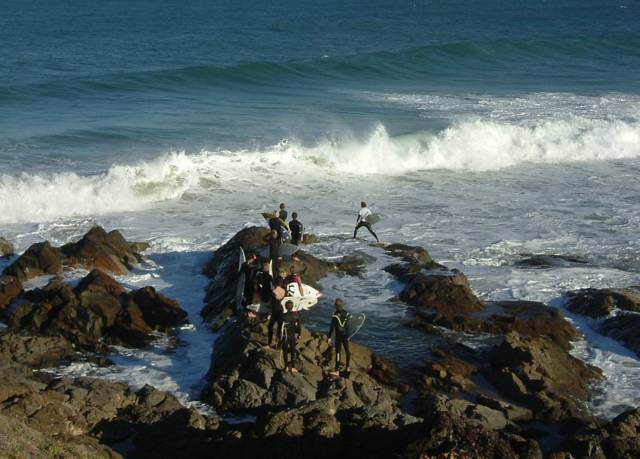
Wandered over the headland to McCauley’s Beach the other afternoon, where the New South Wales junior surfing championship was taking place.
We’d had a few days of storms so the surf was pretty big, so much so that many of the competitors decided against wasting their energy battling out through the waves to the break. Instead they scampered, barefoot of course, round the bottom of the headland and out on to the rocks, where they waited for an incoming wave to break around them before flinging themselves and their boards into the sea and doing their stuff in front of the judges, who were comfortably set up on the beach, under a sunshade with a pair of binoculars and in sniffing distance of the barbecue.

Waiting to compete...
Apparently, it’s normal practice. It’s certainly something you wouldn’t see at home - 13 and 14-year-olds in an official competition being allowed to jump into the foaming waters without any supervision, life-jackets or lifeguards - at least not without howls of outrage and calls for the prosecution of all involved.
There’s also a tradition of fishing off such rocks and of fishermen entering the water involuntarily, courtesy of large waves, and being swept to a salty grave.
We’d had a few days of storms so the surf was pretty big, so much so that many of the competitors decided against wasting their energy battling out through the waves to the break. Instead they scampered, barefoot of course, round the bottom of the headland and out on to the rocks, where they waited for an incoming wave to break around them before flinging themselves and their boards into the sea and doing their stuff in front of the judges, who were comfortably set up on the beach, under a sunshade with a pair of binoculars and in sniffing distance of the barbecue.
Waiting to compete...
Apparently, it’s normal practice. It’s certainly something you wouldn’t see at home - 13 and 14-year-olds in an official competition being allowed to jump into the foaming waters without any supervision, life-jackets or lifeguards - at least not without howls of outrage and calls for the prosecution of all involved.
There’s also a tradition of fishing off such rocks and of fishermen entering the water involuntarily, courtesy of large waves, and being swept to a salty grave.
Thursday, September 09, 2004
Welcome Rain
We’ve just had 12 hours of steady rain. I realise that may not move or entertain those of you who have just come through what I gather to be the UK’s wettest August since dinosaurs roamed the earth but it’s a welcome event here.
Most of the country is in the grip of drought and has been for some years. Much of New South Wales and the neighbouring states is in deep trouble with no water for cattle or crops and the Government has announced a range of measures to help stricken farmers. All the signs are that everyone had better get used to it. Earlier this year, a group of climate scientists warned that Australia faced higher temperatures, more severe droughts and bushfires, and if that weren’t bad enough, more tropical diseases as well. And you all thought we lived in a veritable paradise, didn’t you?
Well, if you live in a town or a city, you could go on believing that. Unlike the farmers, you don’t see your waterholes and rivers shrinking and your stock dying. Everything looks pretty much as normal unless you take a trip to one of the reservoirs serving your city. In Sydney, for example, they’re down to just over 40 per cent of capacity. They waited until the reservoirs were half-empty before stepping up the water restrictions and now you must not hose your lawn or garden except with a hand-hose and that before 10am and after 4pm on Wednesday, Fridays and Sundays. You can’t use a sprinkler or hose down your car at all and, if your swimming pool holds more than 10,000 litres, you can’t fill it.
Hardly draconian and yet, apparently, half of Sydney’s water is used on gardens. And, according to the Green Industries Group, 5,900 jobs were lost in gardening and related industries before the tighter restrictions above were introduced in June. There are some hard issues here for local politicians.
Here, if you take a drive over Red Hill and down the other side to Karangi, you can inspect Coffs’ own water supply at the Karangi Dam. It’s currently three-quarters full, so looking much healthier than the Sydney reservoirs and we still have the bulk of our annual rainfall to come. Nevertheless, you can keep track of water levels on the net http://www.coffsharbour.nsw.gov.au/www/html/356-overview.asp and the restrictions in force here are at least as severe as those in Sydney.

Non-native plant - future limited?
I find this tougher approach rather comforting, though it seems we’re just as keen on watering our gardens as the Sydney-siders; after a period of rain, consumption drops because people aren’t out with hose pipes. Part of the problem is that people want lawns, which aren’t really a good idea in this climate, and that they’ve planted European and other non-native plants which need the water. The gardens between this house and the beach are incredibly verdant, but it’s not natural; a lot of watering goes on. On the other hand, I haven’t been near the native plants in our garden, planted by the landlord, since we moved in and they’re looking fine.
It all goes to show, I suppose, how much this country has been changed since Europeans arrived here. Can those changes be sustained in the face of global warming? Should they? Already there are signs that the population is tending to move toward the coast, giving up the unequal struggle in the interior. The number of people living in Coffs is predicted to rise from 62,000 to 90,000 by 2021. That’ll be quite a challenge for the people who manage the Karangi Dam.
Most of the country is in the grip of drought and has been for some years. Much of New South Wales and the neighbouring states is in deep trouble with no water for cattle or crops and the Government has announced a range of measures to help stricken farmers. All the signs are that everyone had better get used to it. Earlier this year, a group of climate scientists warned that Australia faced higher temperatures, more severe droughts and bushfires, and if that weren’t bad enough, more tropical diseases as well. And you all thought we lived in a veritable paradise, didn’t you?
Well, if you live in a town or a city, you could go on believing that. Unlike the farmers, you don’t see your waterholes and rivers shrinking and your stock dying. Everything looks pretty much as normal unless you take a trip to one of the reservoirs serving your city. In Sydney, for example, they’re down to just over 40 per cent of capacity. They waited until the reservoirs were half-empty before stepping up the water restrictions and now you must not hose your lawn or garden except with a hand-hose and that before 10am and after 4pm on Wednesday, Fridays and Sundays. You can’t use a sprinkler or hose down your car at all and, if your swimming pool holds more than 10,000 litres, you can’t fill it.
Hardly draconian and yet, apparently, half of Sydney’s water is used on gardens. And, according to the Green Industries Group, 5,900 jobs were lost in gardening and related industries before the tighter restrictions above were introduced in June. There are some hard issues here for local politicians.
Here, if you take a drive over Red Hill and down the other side to Karangi, you can inspect Coffs’ own water supply at the Karangi Dam. It’s currently three-quarters full, so looking much healthier than the Sydney reservoirs and we still have the bulk of our annual rainfall to come. Nevertheless, you can keep track of water levels on the net http://www.coffsharbour.nsw.gov.au/www/html/356-overview.asp and the restrictions in force here are at least as severe as those in Sydney.

Non-native plant - future limited?
I find this tougher approach rather comforting, though it seems we’re just as keen on watering our gardens as the Sydney-siders; after a period of rain, consumption drops because people aren’t out with hose pipes. Part of the problem is that people want lawns, which aren’t really a good idea in this climate, and that they’ve planted European and other non-native plants which need the water. The gardens between this house and the beach are incredibly verdant, but it’s not natural; a lot of watering goes on. On the other hand, I haven’t been near the native plants in our garden, planted by the landlord, since we moved in and they’re looking fine.
It all goes to show, I suppose, how much this country has been changed since Europeans arrived here. Can those changes be sustained in the face of global warming? Should they? Already there are signs that the population is tending to move toward the coast, giving up the unequal struggle in the interior. The number of people living in Coffs is predicted to rise from 62,000 to 90,000 by 2021. That’ll be quite a challenge for the people who manage the Karangi Dam.
Tuesday, August 31, 2004
They Don't Give Up....Sometimes
More on the rowing fiasco (see Row, Row, Row Your Boat). This is worth reading: The Bladder At least it's funny.
Thursday, August 26, 2004
My First Snake
Wandering down to Diggers Beach this afternoon, I was stopped by an elderly neighbour on his way home from his daily stroll. "Want to see a beautiful bit of local wildlife?" he asked. I said I did, reasoning that it was bound to be something exotic or deadly, or possibly both. He directed me to the rubbish bins at the far end of the car park where he told me I'd find a carpet snake. "Don't hurt him," he called after me. "He won't hurt you."
And there he was, elegantly draped over the stainless steel post between the two bins, about five feet long and brown, with yellow and black markings. His tail was hidden under several coils on top of the post, most of his body hanging down before making a sharp u-turn so his neck and slender head were pointing upward. He was completely motionless, perhaps because the afternoon had turned cool. They're a kind of python and therefore harmless unless you happen to be a small rodent or bird, I suppose.
And there he was, elegantly draped over the stainless steel post between the two bins, about five feet long and brown, with yellow and black markings. His tail was hidden under several coils on top of the post, most of his body hanging down before making a sharp u-turn so his neck and slender head were pointing upward. He was completely motionless, perhaps because the afternoon had turned cool. They're a kind of python and therefore harmless unless you happen to be a small rodent or bird, I suppose.
Tuesday, August 24, 2004
Row, Row, Row Your Boat.....
You’ll not be surprised to hear that the Australian media is in the grip of Olympic fever. I assume it’s the same back in the UK but, since long before the Sydney games, the Australians have been plotting how to turn themselves into the world’s greatest sporting nation, despite the fact that there’s only 20 million of them (see previous posting - Sink or Swim).
Sport in general, and the Olympics in particular, offers a great opportunity for celebrating two much-prized qualities, toughness and mate-ship, the latter embracing women as well as men, at least in sport. So you can perhaps imagine the horror when one of the members of the women’s rowing eight, well, just stopped rowing. And that when they were in contention for gold. Sally Robbins says she was overcome by exhaustion, translated by the media into losing her bottle, giving up, and betraying her team-mates. Yes, her team-mates were apparently angry. According to Sally, some of them immediately suggested that she might be more comfortable in the water, rather than in the boat, and offered to help her move, though this morning‘s bulletins merely said that her team-mates “expressed disappointment“ with her. I bet they did.
Luckily for Sally, she’s not the only one. There was some scathing coverage of Paula Radcliffe’s withdrawal from the marathon. Not only was she the race favourite, but she’s also British, which is added cause for schadenfreude. There’s a big debate about whether Australia should align itself, culturally and politically, with south-east Asia, New Zealand or America but they seem to have decided they’ve finished with Britain. As one Australian academic pointed out in another context, this country was founded on rejection by Britain. So this morning’s Daily Telegraph (no resemblance to the British one) pointed out that the women all ran the same course, in the same heat, including the same hills, and lots of them managed to finish. But not Paula.
I don’t think anyone but the athletes themselves understand the pressure of preparing for, and competing in, something like the Olympics. Amateur athletes who have run or cycled themselves to a pain-racked standstill will have some inkling but at least they can humiliate themselves more or less in private. But if there’s one group that’s not qualified to castigate Sally and Paula (and thank goodness it wasn’t a bloke who packed) surely it’s journalists. Newsrooms are inhabited by some of the least fit and healthy people on earth and while you can, I think, comment fairly on something like politics by observing and associating with politicians, I don’t think you can begin to accuse athletes of moral failure unless you’ve felt some of their pain personally. And perhaps not even then.
This is not confined to the Australian media, of course. I once tried to commission some coverage for one of my programmes about the Snowdonia Marathon , only to be rejected by the sports department on the grounds that “it wasn’t a proper race.” This verdict was delivered by someone so over-weight and out of condition that I suspected him of using a golf-buggy to move between his office and the newsroom. I consoled myself with a personal vision of the agonies this person would suffer if, by some miracle, he ever managed to drag his bulk around the course. I’d run the race myself so came up with some very vivid and satisfying pictures and organised my own coverage.
PS On a happier note, the rainbow lorikeets have returned to the garden after the winter. They’re as rowdy and acrobatic as ever and they’re very welcome.
Sport in general, and the Olympics in particular, offers a great opportunity for celebrating two much-prized qualities, toughness and mate-ship, the latter embracing women as well as men, at least in sport. So you can perhaps imagine the horror when one of the members of the women’s rowing eight, well, just stopped rowing. And that when they were in contention for gold. Sally Robbins says she was overcome by exhaustion, translated by the media into losing her bottle, giving up, and betraying her team-mates. Yes, her team-mates were apparently angry. According to Sally, some of them immediately suggested that she might be more comfortable in the water, rather than in the boat, and offered to help her move, though this morning‘s bulletins merely said that her team-mates “expressed disappointment“ with her. I bet they did.
Luckily for Sally, she’s not the only one. There was some scathing coverage of Paula Radcliffe’s withdrawal from the marathon. Not only was she the race favourite, but she’s also British, which is added cause for schadenfreude. There’s a big debate about whether Australia should align itself, culturally and politically, with south-east Asia, New Zealand or America but they seem to have decided they’ve finished with Britain. As one Australian academic pointed out in another context, this country was founded on rejection by Britain. So this morning’s Daily Telegraph (no resemblance to the British one) pointed out that the women all ran the same course, in the same heat, including the same hills, and lots of them managed to finish. But not Paula.
I don’t think anyone but the athletes themselves understand the pressure of preparing for, and competing in, something like the Olympics. Amateur athletes who have run or cycled themselves to a pain-racked standstill will have some inkling but at least they can humiliate themselves more or less in private. But if there’s one group that’s not qualified to castigate Sally and Paula (and thank goodness it wasn’t a bloke who packed) surely it’s journalists. Newsrooms are inhabited by some of the least fit and healthy people on earth and while you can, I think, comment fairly on something like politics by observing and associating with politicians, I don’t think you can begin to accuse athletes of moral failure unless you’ve felt some of their pain personally. And perhaps not even then.
This is not confined to the Australian media, of course. I once tried to commission some coverage for one of my programmes about the Snowdonia Marathon , only to be rejected by the sports department on the grounds that “it wasn’t a proper race.” This verdict was delivered by someone so over-weight and out of condition that I suspected him of using a golf-buggy to move between his office and the newsroom. I consoled myself with a personal vision of the agonies this person would suffer if, by some miracle, he ever managed to drag his bulk around the course. I’d run the race myself so came up with some very vivid and satisfying pictures and organised my own coverage.
PS On a happier note, the rainbow lorikeets have returned to the garden after the winter. They’re as rowdy and acrobatic as ever and they’re very welcome.
Saturday, August 07, 2004
Spiders Not That Bad Either - Official
Hope you're all coming to terms with sharks after the posting below and I can now tell you that one of the other great lurking threats in Australian life, spiders, are not all they're cracked up to be either.
"Experts" ie two doctors, one from Australia and one from California, say most pose no threat to humans and are scapegoats for flesh-eating lesions. "Diagnosis of a spider bite continues to be based on mainly on suspicion and fear of spiders, and diagnosis of a chronic ulcer in stories of suspected spider bites causing devastating necrotic fasciitis (flesh eating disease)", they say.
Apparently, the wolf spider and the white-tail spider are the main species unjustly blamed, usually becuase they just happened to be hanging around when some poor person's flesh started eating itself. And in an extension of the sharks versus very big lorries analogy, they point out there have been only 26 deaths from spiders here in Australia in the past century whereas 1,183 people died in motor accidents in 2001.
Thought you should know. But my visiting son, Iwan, still refuses to share the small downstairs toilet with the burly Huntsman that crept in the other day.
More shark news - The Coffs Harbour Advocate reports today that a spearfisherman from Byron Bay was the centre of a media bidding war after being attacked by a grey nurse shark. The Advocate obviously didn't bid high enough so I can't tell you what happened but it have a jolly picture of the fisherman on his hospital bed with what seems to be one-and-a-half legs.
"Experts" ie two doctors, one from Australia and one from California, say most pose no threat to humans and are scapegoats for flesh-eating lesions. "Diagnosis of a spider bite continues to be based on mainly on suspicion and fear of spiders, and diagnosis of a chronic ulcer in stories of suspected spider bites causing devastating necrotic fasciitis (flesh eating disease)", they say.
Apparently, the wolf spider and the white-tail spider are the main species unjustly blamed, usually becuase they just happened to be hanging around when some poor person's flesh started eating itself. And in an extension of the sharks versus very big lorries analogy, they point out there have been only 26 deaths from spiders here in Australia in the past century whereas 1,183 people died in motor accidents in 2001.
Thought you should know. But my visiting son, Iwan, still refuses to share the small downstairs toilet with the burly Huntsman that crept in the other day.
More shark news - The Coffs Harbour Advocate reports today that a spearfisherman from Byron Bay was the centre of a media bidding war after being attacked by a grey nurse shark. The Advocate obviously didn't bid high enough so I can't tell you what happened but it have a jolly picture of the fisherman on his hospital bed with what seems to be one-and-a-half legs.
Friday, August 06, 2004
Shark tales
Just back from a trip to Sydney, this time to show Iwan the sights, which have to include the wonderful Aquarium. There you not only get to see everything from seadragons to the massive Murray cod, but also a group of large sharks.
Visitors can walk through glass tubes in the huge tank they share with sting rays, turtles and presumably nervous fish and it’s probably the only chance you’ll get to appreciate their muscularity, the malevolence of their eyes and the horror of their rows of inward-pointing teeth and emerge with all your flesh.
Even though they spend so much time in the water, people here are pretty relaxed about sharks. As one surfer with all his limbs said to me: “Yes, there are sharks out there but there are also very large trucks on the highway which can do an equally good job of spoiling your day.” In fact, many of these road trains end up on their sides after mysteriously failing to take bends which have been bends on that bit of road for a very long time and therefore shouldn’t come as a surprise to any driver but that’s another matter.
Anyway, here are two sharks tales which say a lot about the Australian attitude to what David Attenborough would no doubt describe as “these complex and fascinating predators.”
Matt, a vet who lives near Coffs was pleased one morning to find only one other surfer in the water on his favourite beach so quickly made his way out to the break. After a while he noticed the other surfer leave the water and limp slowly up the path to the car park. A small crowd then gathered on the path, apparently watching Matt. Watching surfers is a pleasant and common pastime so he didn’t think anything of it.
When he’d had his fill, Matt left the water and made his way up the path toward the crowd. As he approached, one man came toward him and asked: “So you didn’t see the shark, then?”
“What shark?” Matt inquired.
“The one that bit that other guy.”
And, no, Matt tells me he didn’t feel particularly aggrieved that they hadn’t warned him. It’s all about perception of risk, apparently, and also quite amusing.
The other story was in several newspapers and therefore must be true. On a beach to the south of here, a surfer suddenly found a small shark firmly attached to his leg. Remaining calm, he left the water and tried to encourage the shark to let go but it wouldn’t. So he walked (rather awkwardly, no doubt) to his car and drove himself to the nearest surf life saving club. I’m assuming that all his mates were too busy surfing to take the wheel.
When he arrived, he told the lifeguards of his predicament (“excuse me, mate, I’ve got a shark stuck on my leg”) and, when they stopped laughing, they put him and the shark in a freshwater shower and the shark finally let go. The papers were silent on the fate of the shark but I’m also assuming that they then cooked and ate it. That would seem about right.
Wednesday, July 28, 2004
Mail boxes

I saw this group of mail boxes on a trip out into the country. You see lots them by the side of the road, sometimes in groups, like these, or sometimes standing solitary. Some of them are bought, ready-made, from a hardware store but mostly they‘re just made from junk - old metal drums, plastic containers, anything that can be cut open at one end and nailed to some kind of support.
Occasionally, you see some that are real works of art, complex metalwork creations, weatherproofed sculptures of birds, animals or strange machines, and you can almost picture their creators in their workshops down the end of the farm track, designing yet another mail box as a way of relaxing after a hard day on the land.
Mostly, though, they’re just bits of recycling left to stand out in all weathers, mostly blazing sun and wind-blown dust but some torrential rain, by the side of the road, just about affording some protection for the mail left inside. They seem rather frail and vulnerable, and not really up to the job of protecting what’s inside. After all, in spite of the web, lots of important stuff still comes by mail - from banks, the utility companies, solicitors - so why leave it in the care of half an old seed drum?
You can stand by many of them and scour the surrounding landscape for the house they serve without seeing a sign of habitation. The owners clearly don’t take a casual stroll down to pick up their mail and would more likely drive or check it when they were getting into the ute to go into the nearest town. The boxes are really out on a limb, almost abandoned. And yet no one worries about their mail being stolen, which says a lot for rural communities.
The one below seems to have a definite identity - 287 Irvines Road. If you were in a town, you’d look at an A to Z and find Irvines Road but here there’s just the tarmac road from Macksville to Bowraville and then the two dirt tracks heading off who knows where, both unmarked. And there’s no sight of number 287, or 285, or 289. Just the mail boxes.

Monday, July 19, 2004
Sink or swim
One of the things I like about Australia is that there’s always someone exercising and there’s always someone sitting in a café, often after they’ve been exercising. I’m glad to say that that I’m doing my bit to maintain this admirable state of affairs but I’ve had to withstand some cultural intimidation along the way. Exercise, and sport, is taken very seriously.
Fired by my enthusiasm to stay afloat and alive on the local beach - Diggers has a mysteriously mobile and treacherous rip that has been known to draw away unsuspecting holidaymakers - I decided to take myself off to the proudly named Coffs Harbour War Memorial Olympic Pool (I should say that “Olympic” refers to its size and, apparently, the aspirations of its regular users; the Games have never been held here).
It took me a few visits before I made it across the threshold, even at 9am, because for weeks the pool was booked for school competitions right through to lunchtime. Before 9am, the pool was used for “squads”, as one of the attendants told me. I didn’t bother asking which squads because I took it for granted that in every town, in every sport, every morning across Australia, “squads” are at work, striving for sporting domination, and possibly even enjoying it. They then go to the nearest café.
When I finally made my way in, it was very different to the siege-like atmosphere in many British public pools. I asked the jolly woman on the gate if they had lockers. “We do,” she replied. “But they’re not worth the trouble so if you‘ve got any valuables, you’d better give them to me.” She put my wallet and keys next to someone’s sandwiches on a shelf. No one bothers with the changing rooms, either. You arrive wearing your swimmers, shorts and a t-shirt so it’s straight to the pool, which is open-air and so vast, you can barely see the other end. In March, the air was pleasantly warm and the unheated water pleasantly cool and I started working on the only stroke available to me, the breast stroke, which, with practice, becomes reasonably efficient, despite my habit of lying in the water at an angle, like a surfacing submarine with a surfeit of ballast in the stern.
I flogged up and down, feeling glad the pool was empty as I was going so slowly (oh yes, there were no lifeguards; they seem to have no need for them). A couple more swimmers drifted in - there were never more than a three of us at that time of the morning - and then something like a torpedo went by in the next lane, trailing a stream of bubbles. Of course, I didn’t catch it and humiliation was complete when the torpedo was revealed to be a slim woman in an elegant swimsuit who, though clearly extremely fit and youthful in spirit, was even older than me. I’m fifty, for the record, and it would not be polite to hazard a guess at Ann’s age. We started chatting each morning, before, as she puts it “we’d better get down to business” and she powers off to the distant, far end of the pool while I flounder along in my lane. She also does more lengths than I do.
I’m impressed by Ann and, believe me, there are many more like her, all out there unintentionally humiliating passing Poms. I was even more impressed (yes, ok, even more humiliated) when, after a couple of weeks, she revealed that the pool is her second exercise session of the day and, that before 9am. “I usually go for a walk over Mutton Bird Island with some friends and then we have a long swim off Jetty Beach,” she told me casually. “But I like to do a few lengths here as well.”
Behind the bench where we leave our clothes, a new generation is prepared for the stern business of being Australian. In the teaching pool, protected from the sun by a wooden roof, children who can yet barely walk are having swimming lessons. “Long arms, Monty, long arms,” shouts the instructor. Inside, two small boys are made to race for a ball flung to the far side of the pool. Monty wins by a head, possibly because he has long arms for his age, or he uses his arms in some secret, Aussie-domination-of-sport way that makes his arms seem longer. I notice that they both have floats strapped to their backs, clearly to correct the tilting submarine tendency. If only I’d had their advantages.
Anyway, I’m having a break from all this because the pool has shut for what passes here for winter. I asked the pool’s owner, who works there full-time, how he passed the close season. “Grouting,” he replied. “It’s a big job.” They really are indomitable, these Australians.
Fired by my enthusiasm to stay afloat and alive on the local beach - Diggers has a mysteriously mobile and treacherous rip that has been known to draw away unsuspecting holidaymakers - I decided to take myself off to the proudly named Coffs Harbour War Memorial Olympic Pool (I should say that “Olympic” refers to its size and, apparently, the aspirations of its regular users; the Games have never been held here).
It took me a few visits before I made it across the threshold, even at 9am, because for weeks the pool was booked for school competitions right through to lunchtime. Before 9am, the pool was used for “squads”, as one of the attendants told me. I didn’t bother asking which squads because I took it for granted that in every town, in every sport, every morning across Australia, “squads” are at work, striving for sporting domination, and possibly even enjoying it. They then go to the nearest café.
When I finally made my way in, it was very different to the siege-like atmosphere in many British public pools. I asked the jolly woman on the gate if they had lockers. “We do,” she replied. “But they’re not worth the trouble so if you‘ve got any valuables, you’d better give them to me.” She put my wallet and keys next to someone’s sandwiches on a shelf. No one bothers with the changing rooms, either. You arrive wearing your swimmers, shorts and a t-shirt so it’s straight to the pool, which is open-air and so vast, you can barely see the other end. In March, the air was pleasantly warm and the unheated water pleasantly cool and I started working on the only stroke available to me, the breast stroke, which, with practice, becomes reasonably efficient, despite my habit of lying in the water at an angle, like a surfacing submarine with a surfeit of ballast in the stern.
I flogged up and down, feeling glad the pool was empty as I was going so slowly (oh yes, there were no lifeguards; they seem to have no need for them). A couple more swimmers drifted in - there were never more than a three of us at that time of the morning - and then something like a torpedo went by in the next lane, trailing a stream of bubbles. Of course, I didn’t catch it and humiliation was complete when the torpedo was revealed to be a slim woman in an elegant swimsuit who, though clearly extremely fit and youthful in spirit, was even older than me. I’m fifty, for the record, and it would not be polite to hazard a guess at Ann’s age. We started chatting each morning, before, as she puts it “we’d better get down to business” and she powers off to the distant, far end of the pool while I flounder along in my lane. She also does more lengths than I do.
I’m impressed by Ann and, believe me, there are many more like her, all out there unintentionally humiliating passing Poms. I was even more impressed (yes, ok, even more humiliated) when, after a couple of weeks, she revealed that the pool is her second exercise session of the day and, that before 9am. “I usually go for a walk over Mutton Bird Island with some friends and then we have a long swim off Jetty Beach,” she told me casually. “But I like to do a few lengths here as well.”
Behind the bench where we leave our clothes, a new generation is prepared for the stern business of being Australian. In the teaching pool, protected from the sun by a wooden roof, children who can yet barely walk are having swimming lessons. “Long arms, Monty, long arms,” shouts the instructor. Inside, two small boys are made to race for a ball flung to the far side of the pool. Monty wins by a head, possibly because he has long arms for his age, or he uses his arms in some secret, Aussie-domination-of-sport way that makes his arms seem longer. I notice that they both have floats strapped to their backs, clearly to correct the tilting submarine tendency. If only I’d had their advantages.
Anyway, I’m having a break from all this because the pool has shut for what passes here for winter. I asked the pool’s owner, who works there full-time, how he passed the close season. “Grouting,” he replied. “It’s a big job.” They really are indomitable, these Australians.
Tuesday, July 06, 2004
Bowraville
We went to Bowraville the other day, a small town inland and to the south of here. It’s easy to find. You just drive down the Pacific Highway for about an hour, turn left and keep driving for another twenty minutes or so. And you’re there. Similarly, you can reduce the directions for getting to us from Brisbane to “drive south on the highway for six hours, turn left at the Big Banana and we’re the fifth house on the right.” If you’re coming from Sydney, then you just drive north for eight hours and turn right at the Big Banana. That’s the sort of country it is.
It’s a small town and very quiet, the kind of place where, although thriving, you’d expect tumbleweed to greet you on the main street but it is just quiet and not abandoned at all. It was founded by cedar getters in 1850 though, of course, indigenous people were living there and still do. Cedar was known as “red gold” but real gold played a part in the town as well. In 1881, two brothers looking for stray bullock found traces of gold in a stone in the remains of a still-warm campfire and staked a claim. This was then promptly disputed by the men who had built the campfire as soon as they heard about it. But there was still mining in the area until the 1960s.

Bowraville Theatre
The buildings are old, for this country, and well-preserved. It has most things - a town clock, a hotel, a couple of lodging houses, a butcher, food store, a couple of cafes, and a race course. It also has a theatre, recently restored and re-opened by the town’s arts council, after more than 40 years. In its previous existence as the Raymond Theatre, the audience was segregated, the indigenous Gumbaynggir people sitting on inferior seats nearest the stage. The practice was highlighted in the sixties by a group of student civil rights campaigners known as the Freedom Riders and, eventually, the owner closed the theatre rather than face de-segregation. Now it’s been fully restored and, following a cleansing ceremony to mark the break with the past, there’s a programme of films, bush poetry readings and music.
The chair of the arts council is Dorothy James. Now in her seventies and not shy about it at all, she comes originally from Mumbles (and turned out to have gone to the same school as Sara’s father; and Sara’s mum knew Dorothy’s brother). After we’d all seen the theatre, she took us back to her home outside the town, a bungalow perched on the side of a valley with views from a wide verandah down to a creek and up the other side of the valley over fields and hillsides. In Britain, you’d call it isolated. She has a lively cattle dog, Ruby, and an old horse for immediate company, and has family living on a farm nearby. They were away for a weekend when we visited and Dorothy was happily looking after their ponies, dogs and chooks ie chickens. You got the impression this was all in a day’s work and more than welcome.
It’s a small town and very quiet, the kind of place where, although thriving, you’d expect tumbleweed to greet you on the main street but it is just quiet and not abandoned at all. It was founded by cedar getters in 1850 though, of course, indigenous people were living there and still do. Cedar was known as “red gold” but real gold played a part in the town as well. In 1881, two brothers looking for stray bullock found traces of gold in a stone in the remains of a still-warm campfire and staked a claim. This was then promptly disputed by the men who had built the campfire as soon as they heard about it. But there was still mining in the area until the 1960s.

Bowraville Theatre
The buildings are old, for this country, and well-preserved. It has most things - a town clock, a hotel, a couple of lodging houses, a butcher, food store, a couple of cafes, and a race course. It also has a theatre, recently restored and re-opened by the town’s arts council, after more than 40 years. In its previous existence as the Raymond Theatre, the audience was segregated, the indigenous Gumbaynggir people sitting on inferior seats nearest the stage. The practice was highlighted in the sixties by a group of student civil rights campaigners known as the Freedom Riders and, eventually, the owner closed the theatre rather than face de-segregation. Now it’s been fully restored and, following a cleansing ceremony to mark the break with the past, there’s a programme of films, bush poetry readings and music.
The chair of the arts council is Dorothy James. Now in her seventies and not shy about it at all, she comes originally from Mumbles (and turned out to have gone to the same school as Sara’s father; and Sara’s mum knew Dorothy’s brother). After we’d all seen the theatre, she took us back to her home outside the town, a bungalow perched on the side of a valley with views from a wide verandah down to a creek and up the other side of the valley over fields and hillsides. In Britain, you’d call it isolated. She has a lively cattle dog, Ruby, and an old horse for immediate company, and has family living on a farm nearby. They were away for a weekend when we visited and Dorothy was happily looking after their ponies, dogs and chooks ie chickens. You got the impression this was all in a day’s work and more than welcome.
Thursday, July 01, 2004
Warning: Vortex looming
Feeling as though I'm being stalked by those ads at the top of the page. No sooner had I finished yesterday's posting, than they seized on the word "morning" and produced an offer for a video of film called "Joy in the Morning", starring Richard Chamberlain, for heaven's sake. I thought he'd gone to soap opera hell with his alter ego, Dr Kildare. Now they've changed and they seem to have been thinking about the word "breakfast." No doubt this posting will initiate some digital head-scratching and brow-furrowing. It's relentless. Should I stop now before I'm sucked into a post-modern vortex of self-reference, swirling around in hyper-space with cockroaches, Mortein, wallabies and humpbacked whales? Where will it all end?
Subscribe to:
Posts (Atom)

